“Our cargo doesn’t fit. These truck bodies don’t work for our business.”
No one wants to hear those words from a customer, especially after an entire fleet of truck bodies has been built and delivered. But that’s exactly what happened to one Wabash leasing partner. A fleet of truck bodies was spec’d using just the outside width, not the interior space required to fit the customer’s cargo. And it wasn’t until the units were delivered to the customer that the mistake was realized: The cargo didn’t fit, and the bodies couldn’t be used.
To make it right, the leasing partner bought back the units—a costly reminder that the details decide a unit’s effectiveness.
But what if an engineering expert had been in the room early on to capture those details? Someone who could have listened to the customer’s needs and challenges, and helped translate those to the right technical solution, before it became an order?
That’s what Wabash’s newly created Applications Engineering (AE) team is built to do.
If you’re a sales director or manager who quotes, specs, and sells equipment—but aren't yourself an engineer—this is a team you want to know, to help prevent mistakes like this from happening to customers, from happening to you. And AE won’t just help avoid costly mistakes: They will also handle the technical questions, so you can focus on the relationship and the business.
Meet Applications Engineering
“We’re a customer-focused engineering function that supports the commercial team,” said Travis McCloud, whose 20-year engineering career with Wabash now has him leading the AE team as director. “AE is where customer problems, sales opportunities, and Wabash technical capability come together.”
It was McCloud that saw the need for a team like AE and advocated for creating it. The AE team now exists to help customers understand their operation, identify the real problem or opportunity, and then connect them with a solution that Wabash can build, support, and stand behind.
“We’re that technical bridge that turns customer needs into a practical, valuable outcome,” said McCloud.
Pulled from other product engineering roles to specifically support sales-led roles, AE’s team members carry deep technical knowledge of Wabash’s extensive and configurable product line. Team members are capable of solving a wide range of technical challenges, but they also pull from Wabash’s elite ecosystem of subject matter experts depending on the challenge.
“My team’s trained to recognize where their limits are and bring the right person to the party,” McCloud said.
Why timing matters
In AE’s early planning days, McCloud mapped the customer journey, a practice that surfaced a problem: By the time a spec exists, the customer has already settled on the solution, and Wabash was just reacting to a decision essentially made without them. At that point, Wabash was “just quoting against the competition” without ever getting to be a part of what they were quoting for.
McCloud and his team identified the right time to bring AE in: before the quote and before the spec.
“Application engineering was built to engage with customers early in the process,” McCloud said. “Earlier is better.”
This way, AE can strategically partner with sales team members and customers to shape the solution and even make sure the right problem is being solved to begin with. They do this through an application review that evaluates whether a solution actually fits how the customer will use the equipment, a fundamentally different and more valuable conversation than just a spec review.
“I keep preaching,” said McCloud, “that we don't want to do spec reviews. We want to do application reviews. That’s where the value is for our team and where we sit in that process is early on.”
Including the team early helps protect trailer spec accuracy and prevent costly change orders for a frictionless customer experience.
The signals to listen for
It should be noted that not every conversation calls for an engineer: AE is a premium service reserved for strategic, enterprise-value opportunities. For these opportunities, you’ll want to engage AE if your customer goes beyond a quote to describe an operating problem. Listen for signals of friction, uncertainty, complexity, or risk. Phrases like:
- “We’ve had issues with this before.”
- “Our current setup doesn't work that well."
- "We need something similar to this but not exactly something standard."
Or a quote with custom text signals they're searching for a solution or have a unique problem they're trying to solve.
Having an engineer in the room for these conversations changes the dynamic of a meeting to your benefit and can help win business in ways that go beyond the technical piece.
First, it takes the pressure off your having to answer technical questions; instead, you can focus on nurturing the relationship and supporting the business. AE can help ensure you’re pinpointing the customer’s exact needs, so you know you’re bringing the right products and solutions to the table. An engineer’s presence also helps build trust and credibility with the customer, and that reflects on you. When the customer trusts what they’re hearing, they trust the person who brought that expertise to the table in the first place.
What working with Applications Engineering looks like
Once AE is involved, it’s not just about adding them to a call. AE has a process, and it starts with homework. Using tools purpose-built for customer research, they get down to business, digging into what the customer does, what the customer wants to accomplish, and whether they’ve had past equipment issues. The goal is to be prepared with context for a productive first meeting. Then it’s all about being a good listener.
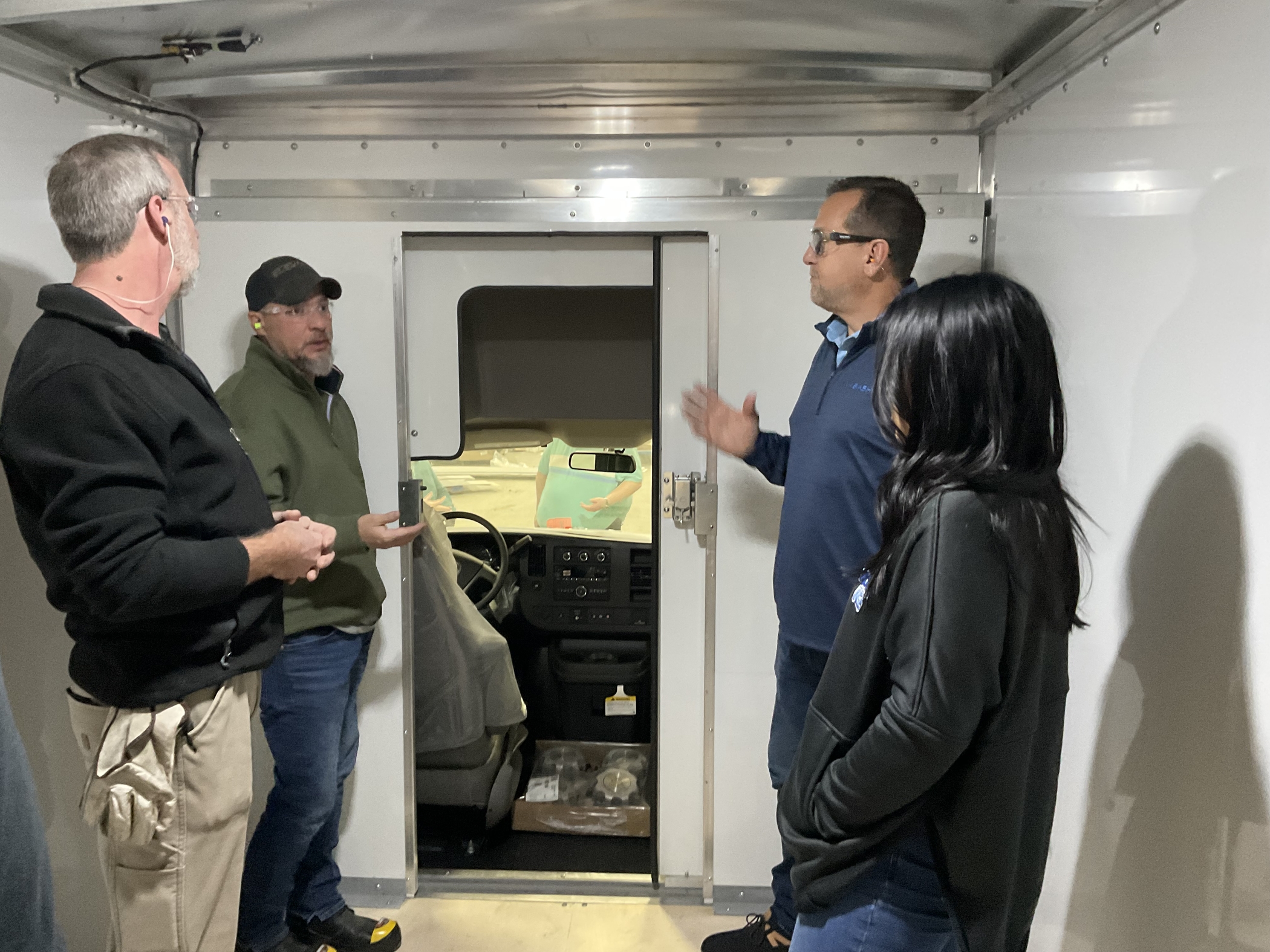
“What we find is that customers tend to open up and be a little more honest when there’s an engineer around,” McCloud said.
Coming out of that first sit-down, AE often already has a vision for the solution and begins building their plan of action. Rather than building in silos, they bring the customer along on their journey, before anything is spec’d or built.
One example of this: For configurable products like service bodies, where features like shelves, tanks, pumps, and workbenches all have to fit together, AE likes to build a 3D design model of the equipment and present it in a live virtual review. The customer’s own technicians can actually move components around on-screen in real time, giving AE the opportunity to hear directly from the people who will use the equipment every day. Often the result is an order.
This way of working makes for a much smoother process. It means fewer surprises for the customer. It means fewer change orders and lower costs. It means a faster on-time-to-promise. It’s a big win for the customer.
Real results
AE goes beyond architecting product solutions, also developing training and tooling so the impact lasts.
Take our earlier story, where a fleet of truck bodies was spec’d using only the outside width, which didn’t capture the interior width and what happens to it when you add mechanisms like E-track rails, load bars, and bulkheads. The result was the customer’s cargo didn’t fit, and costly buybacks followed. AE helped turn that unfortunate lesson into something lasting, building a calculator inside the team’s sales configurator to automatically determine interior clearance.
“It was a big win,” McCloud says. “The leasing partner was so excited that we were able to support them like that.”
Sometimes AE’s support extends to engineering a product that’s never existed before. A customer moving temperature-critical biological lab samples couldn't get standard-size trailers into every lab they needed to deliver to. With no existing product or place to start from, AE engineered an elaborate truck body from scratch, completely custom with refrigeration, coolers, generators, and backup systems.
“We helped that customer capture more business,” McCloud said, “because now the customer has a product that works in multiple locations.”
As a result, that customer anticipates an increase in business of at least 10 percent.
While the customers, products, and solutions vary, AE’s goal remains the same, no matter what: that customers have complete confidence in Wabash to deliver the right product for their business. AE has proven results that together make for a frictionless order: better trailer spec accuracy, faster decision-making and higher confidence, improved uptime, lower total cost, and better operational fit.
A technical partner from the start (or at least the second meeting)
AE exists to help customers make better equipment and business decisions before those decisions become expensive to change. That’s why McCloud’s closing message for Wabash's leasing and channel partners is this: Get Applications Engineering involved early.
“We may not be on that first visit,” McCloud said, “but we should probably be on the second visit."
That early involvement gives AE a seat at your table to be your technical bridge between the customer’s needs and a practical, valuable outcome, which helps strengthen your relationship with the customer. So you never have to hear, “Our cargo doesn’t fit. These truck bodies don’t work for our business.”
“We want to listen, we want to translate their needs, and bring the right technical resources to bear,” McCloud said, “and help you show the customer why Wabash is more than just a manufacturer. We want to be your partner and help you solve your customers’ problems.”
Have a complex spec or a customer with a non-standard need? Get in touch with us to get connected.