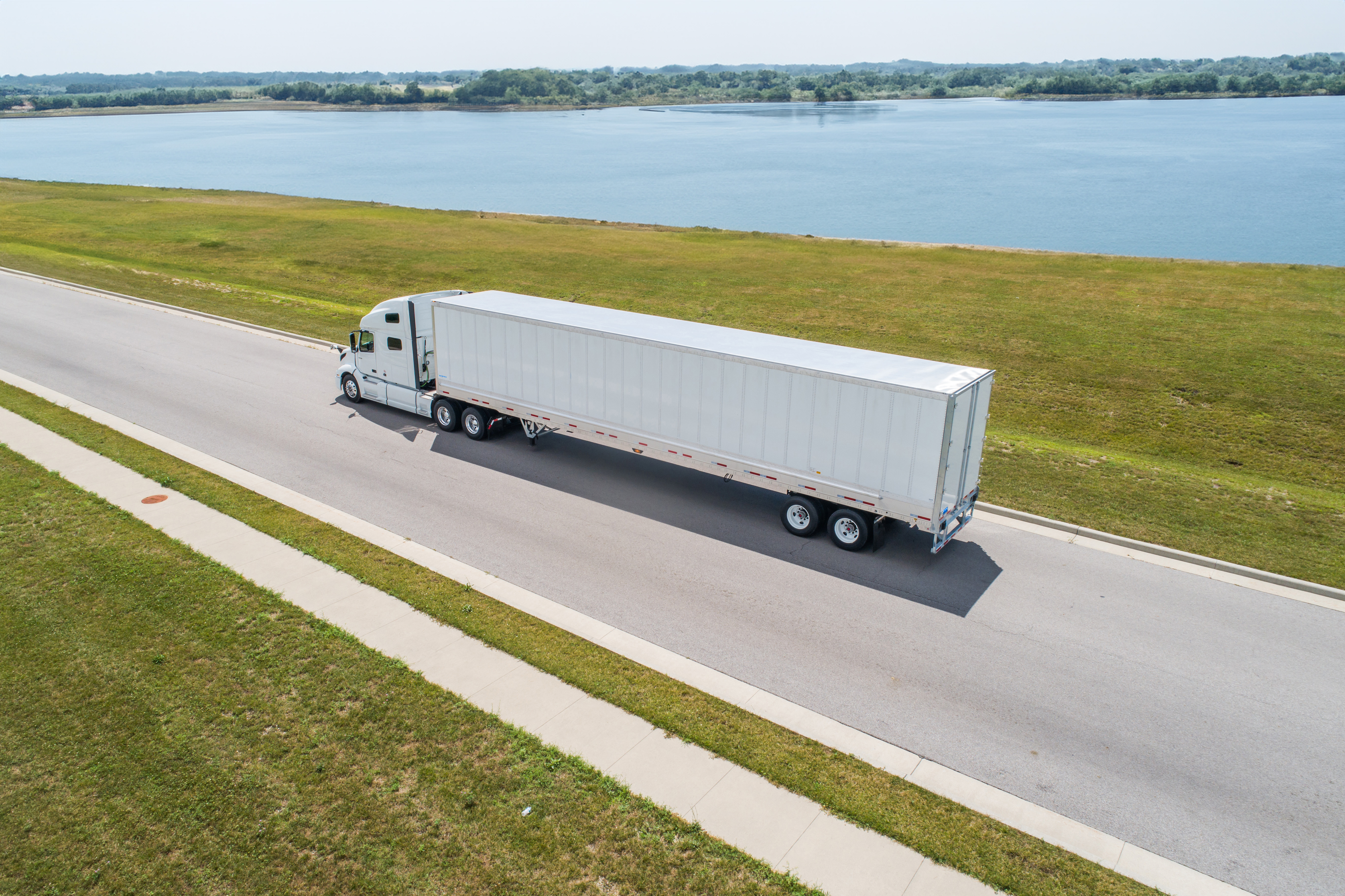
Choosing the dry van trailer that will haul your freight for years to come is a critical
business decision. That one decision affects the operational efficiency, maintenance cost,
and profitability of every trailer in your fleet. And for enterprise fleets managing hundreds
or thousands of trailers with decade-long lifecycles, that purchase decision sets off a
chain of consequences for every trailer in the fleet.
Yet many fleet managers still let the initial price drive their purchasing decision.
Forward-thinking fleet managers focus instead on the total cost of ownership (TCO). How
much will this trailer actually cost to operate and maintain over its usable life? How many
days does it spend in repair and out of service instead of generating revenue? How much
will it go for on the resale market? How many times will we have to buy it again?
When you evaluate dry van trailers through these answers, the gap between traditional
sheet and post trailers and Wabash's DuraPlate® composite panel technology becomes
substantial and backed by measurable data. Not all dry vans are built the same.
The difference between Sheet and Post & DuraPlate
Sheet and post (S&P) is the old-school approach to dry van manufacturing used for
decades. Structural aluminum posts sit at regular intervals (typically 12” or 16” centers),
with thin aluminum sheets (typically .050” thick) attached to the posts as the exterior skin.
The interior lining that protects cargo can be of plywood, plastic lining, or other materials.
S&P remains common in the market primarily because of its lower original equipment
manufacturer (OEM) costs and established production processes.
DuraPlate® is Wabash’s composite panel technology that revolutionized dry van trailer
construction. Its core is a high-density polyethylene (HDPE) that’s laminated on both sides
with pre-coated, galvanized steel skins rated at 80,000 pounds per square inch (psi) yield
strength. The composite panel itself serves as both the structural element and trailer skin,
eliminating the need for a separate post-and-sheet. DuraPlate® Cell Core uses a
mechanically modified HDPE core for additional weight savings, with DuraPlate® HD as
the high-density, high-side-rail variant.
Reason 1: 5x–7x greater impact and puncture resistance
Trailers need to be able to absorb the impacts of a high-throughput dock. To show the
strength and durability of a DuraPlate compared to a standard S&P trailer, Wabash tested
puncture resistance of its trailer sidewalls using two methods: a ½” Ball Test that
simulates a concentrated impact and a 6” Spade Test that represents a forklift tine.
In the ½” Ball Test, DuraPlate withstood 2,100 pounds of force compared to just 260
pounds for an S&P trailer with plywood lining—more than eight times the resistance. In the
6” Spade Test, DuraPlate reached 7,700 pounds versus 700 pounds for S&P
plywood—more than 11 times the resistance.
That means DuraPlate Cell Core has five to seven times the puncture resistance of
traditional liner materials for S&P. For enterprise fleets operating in busy environments
where dock activity is constant and forklift contact is unavoidable, this resistance
differential translates to fewer repair events per trailer per year.
Reason 2: 5–7 years longer service life
Structural differences directly impact trailer longevity, maintenance requirements, and
overall lifecycle performance. S&P construction is inherently vulnerable to the cumulative
effects of daily operational stress. S&P sidewalls can only deflect a few inches before
posts permanently buckle. Seams and attachment points leave trailers more susceptible
to water intrusion. And the materials themselves are susceptible to deterioration as the
trailer ages, which only accelerates your maintenance demands.
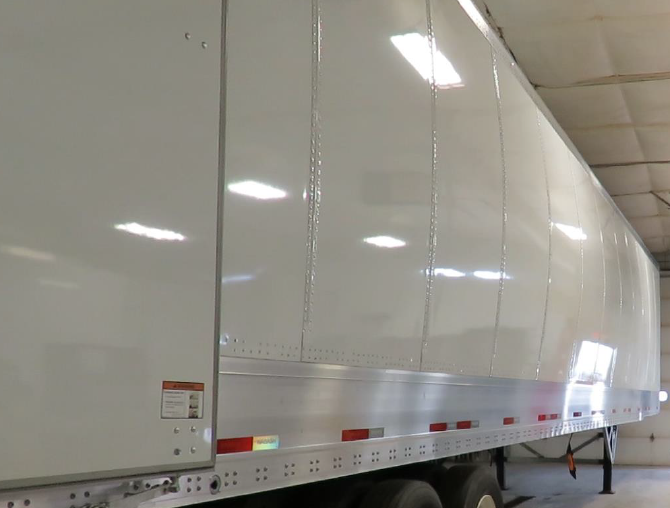
DuraPlate addresses each of these failure points at a structural level. DuraPlate’s panel
can flex up to 12” during operation and return to its original shape without permanent
damage. The header and top rail lap outside the wall panels in a watershed design that
naturally directs water away from the trailer’s seams, joints, and attachment points to
prevent any intrusion. Corner posts run the full length to eliminate gaps. DuraPlate’s
materials resist the rot and delamination that degrades S&P sidewalls over time.
This advanced structural integrity of DuraPlate vans means five to seven years longer
service life compared to traditional S&P design. That changes the economics of trailer
ownership and maintenance and puts enterprise fleets on a longer replacement cycle,
lengthening procurement frequency and keeping assets in service longer.
Reason 3: 33% fewer trailer purchases over 20 years
The length of service life of a DuraPlate changes how many trailers a fleet has to buy. S&P
trailers have a typical service life of six to eight years, requiring three replacement cycles
in 20 years. DuraPlate trailers have a typical service life of 10–12 years, requiring two.
Investing in DuraPlate means investing in 33% fewer trailer purchases over 20 years.
For a 500-trailer fleet, that’s an entire procurement round you never have to run. Every
purchase you don’t make is capital you don’t have to deploy.
Reason 4: Significant weight advantage increases payload potential
Every pound of a trailer’s weight is weight that can’t be freight. DuraPlate Cell Core can be
more than 800 pounds lighter than S&P, with base weights of 12,941 pounds for DuraPlate
Cell Core and 12,995 pounds for DuraPlate HD (Cell Core), compared to 13,510 pounds for
S&P with plywood liner and 13,855 pounds for S&P with plastic liner.
At the federal 80,000-pound gross vehicle weight limit, that 800-pound weight difference
translates directly to payload capacity. An S&P trailer with plywood liner can carry a
maximum of 66,490 pounds of freight. DuraPlate Cell Core can carry 67,059 pounds—an
additional 569 pounds per load.
For enterprise fleets running high-density freight or weight-sensitive commodities, that
per-load revenue difference across hundreds of trailers and thousands of loads adds up.
That number doesn’t appear on your initial purchase order, but it does show up on your
P&L.
Reason 5: Maintenance profile designed for higher uptime
There’s another line on that P&L that you pay attention to: maintenance costs. S&P trailers
are typically subject to more frequent repairs from routine wear and tear, a pattern that
only accelerates as they age. More frequent maintenance reduces their operational
availability. That means the older a trailer gets, the more time it spends out of service and
the less you get out of your original investment.
DuraPlate's maintenance profile is different. Typical repair needs are generally limited to
damages from accidents or collisions, not routine wear and tear. That matters because
collision-driven repairs are episodic and unpredictable; wear-and-tear repairs are chronic
and accumulating. A trailer that only needs attention after an incident, a comparatively
rare event, is a trailer that spends more of its life generating revenue.
The DuraPlate’s drip gutters, full-length corner posts, and embedded marker lights help
improve serviceability and reduce the need for maintenance. Fewer repairs and a longer
floor life mean more productive days, and for fleet directors managing hundreds of
trailers, that translates to greater operational availability and lower total cost.
Reason 6: Lower repair cost per incident
When a DuraPlate trailer does need a repair, it also costs significantly less to fix.
Let’s look at the cost of a standard sidewall repair using the 2021 NTDA Labor Hours
Guide and industry standards for labor and S&P costs. For an S&P repair, which requires
the intensive process of removing and replacing one sheet and three posts, the labor
alone costs $1,377.50. The labor for a DuraPlate composite panel repair, which is a single
panel replacement, costs $769.50. DuraPlate parts cost a little more at $165 versus $105,
but that difference is outweighed by the $608 in labor savings. With tow costs at $1,250
for both, the total repair cost on an S&P trailer comes to $2,732.50; for a DuraPlate trailer,
it’s $2,184.50. That’s $548 less per panel repaired, a 20% cost reduction on every repair
driven almost entirely by labor efficiency.
For a large fleet with even a modest number of sidewall repairs annually, that
$548-per-repair savings will significantly reduce your maintenance spend year after year,
for every trailer in the fleet.
Reason 7: Stronger resale value and secondary market demand
Resale value is a critical piece of the TCO equation, as it directly affects the net cost of
every asset in your fleet. For this, DuraPlate holds its value longer, which extends the life
of the trailer. The structural integrity that drives better impact resistance, longer service
life, and lower maintenance costs shows up in the condition of the asset when it’s time for
the secondary market. DuraPlate trailers typically show less wear and structural fatigue
than comparable S&P trailers, creating a stronger secondary market demand and more
competitive resale.
The more frequent repairs that S&P trailers undergo from routine wear and tear, combined
with deterioration over time, means they often show more visible damage and structural
fatigue by the time they reach trade. That condition makes them more difficult to sell on
the used market. It limits their appeal to second owners and depreciates their value. The
TCO of an S&P asset goes up.
For enterprise fleets managing large trailer pools, a stronger secondary market position
helps recover more capital at trade, effectively reducing the net cost of every trailer
purchase in the population and preserving investment over a longer period. That’s the
advantage of DuraPlate—that every part of the TCO equation works in your favor.
When to prioritize DuraPlate versus when S&P may be viable
Prioritize DuraPlate when:
● Long-term value matters more than initial cost. The documented 5–7 years of
longer service life creates significant TCO advantages that outweigh the initial
price premium.
● Maximum payload matters. DuraPlate Cell Core's more than 800 pounds of
weight savings directly increase payload and revenue potential.
● Reducing repair time and cost is a priority. DuraPlate repairs require
approximately 44% less labor time than S&P, resulting in $548 less per repair
incident and faster return to service.
● Resale positioning matters. DuraPlate vans hold their value longer in the
secondary market due to better condition retention and structural integrity.
Sheet and post may be viable when:
● Initial capital is extremely limited. If you have immediate cash flow constraints,
the lower purchase price may be attractive despite higher lifetime costs.
Conclusion
Freight demands are always evolving and operating costs under pressure. In this
environment, the trailer you buy matters more than ever. Its cost will continue to show up
in every mile, repair, and trade cycle.
Compared to S&P trailers, DuraPlate tells a more powerful TCO story. Stronger, lighter,
and more durable materials require less maintenance and result in lower fuel and repair
costs. Their structural durability retains their value longer and extends their trade and
lifecycles. Increased payload capacity means more freight per load and more time on the
road generating revenue.
Not all dry vans are built the same. For enterprise fleets willing to look beyond the initial
purchase price, DuraPlate delivers substantial value that outperforms and outlasts.
Evaluate DuraPlate for your fleet
Download the full DuraPlate® vs. Traditional Sheet & Post buyer's guide to see the
complete data behind every comparison in this article.
Or speak with a Wabash trailer specialist about fleet standardization and what a DuraPlate
conversion could mean for your TCO.